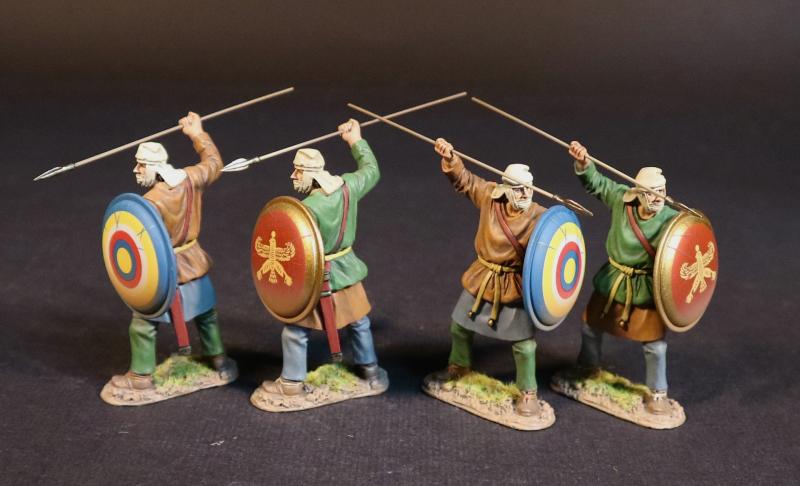
Four Kardake Light Infantrymen in White Caps (2 in light brown tunics, shields painted as bullseyes; 2 in green tunics, red shields), The Achaemenid Persian Empire--four figures stabbing overhand--AWAITING RESTOCK.
$178.00
Future Release
Add to Wish List Notify Me When Available
Item Number: AP-34LN
Four Kardake Light Infantrymen in White Caps (2 in light brown tunics, shields painted as bullseyes; 2 in green tunics, red shields), The Achaemenid Persian Empire, Armies and Enemies of Ancient Greece and Macedonia--four figures stabbing overhand
The Achaemenid Persian Empire, 550-330
ARMIES AND ENEMIES OF GREECE AND MACEDONIA: THE ACHAEMENID PERSIAN ARMY
KARDAKE INFANTRY
The Achaemenid Empire c. 550–330 BCE, also called the First Persian Empire, was an ancient Iranian empire based in Western Asia founded by Cyrus the Great. Ranging at its greatest extent from the Balkans in the west to the Indus Valley in the east, it was larger than any previous empire in history, spanning 5.5 (or 8) million square kilometers. Incorporating various peoples of different origins and faiths, it is notable for its successful model of a centralised, bureaucratic administration (through satraps under the King of Kings), for building infrastructure such as road systems and a postal system, the use of an official language across its territories, and the development of civil services and a large professional army. The empire's successes inspired similar systems in later empires.
The Achaemenid Empire encompassed a vast and diverse range of territories, from Anatolia and Egypt to the Indus Valley. This diversity was reflected in its cavalry, which included units from various ethnic groups such as Medes, Persians, Bactrians, Scythians, and Sakas.
Each group brought its own unique style of cavalry warfare, contributing to the overall effectiveness of the Achaemenid cavalry.
Kardakes translated means “foreign mercenaries”
The Kardakes are a part of the Persian army that also appears towards the later empire, it is uncertain what they really were. Some say that they were mercenaries, others that they were influenced by the Greek Hoplites and that we should assume that they were a Persian attempt to reform the army in a Greek way.
The Kardakes are described by historians as "Hoplites", Slingers and "Peltasts". This may illustrate that Kardakes most likely were not a specific troop type, like a heavy infantryman or a skirmisher, but rather a specific group which supplied several kinds of soldiers. This means that the Kardakes would have been equipped differently. At the battle of Issus, Arrian calls them Hoplites, and Kallisthenes as Peltasts.
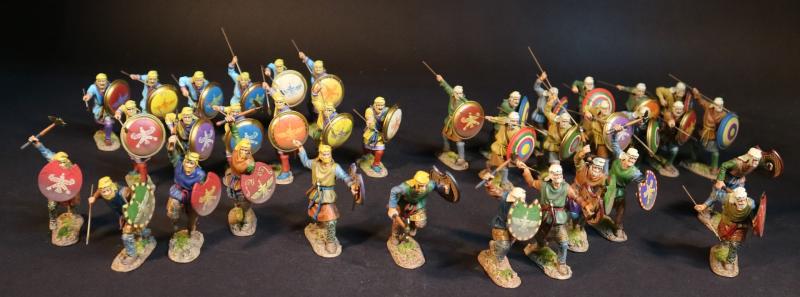
The Kardaka infantryman are based on the Alexander mosaic. Greek hoplite shields are shown as plain bronze, and the others are painted. It is believed that the yellow hooded troops were Persians, although it is also proposed that these could also have been non ethnical Persians. They were believed to have been accorded the status of a Persian bondsman in return for their military service. This would have entitled them to exemption from taxes, a privilege reserved for the Persians, and perhaps the right to be tried according to Persian law. Therefore, it is speculated that the yellow hood may have been the badge of one holding Persian legal status.
If we assume the assumptions concerning the yellow hoods are correct, then it is proposed that the white hoods represent troops of non-Iranian origins.
Released in MAY 2026.
