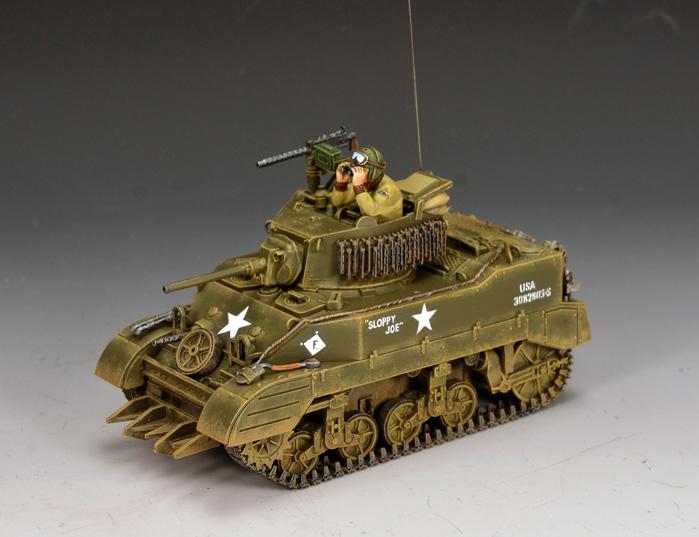
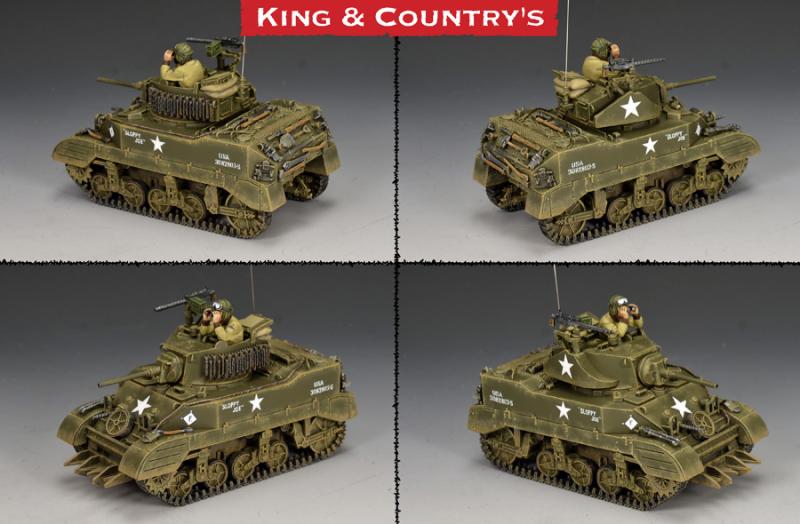
The M5A1 Stuart Bocage Buster--tank, commander figure, and MG
$299.00
Item Number: DD395
The M5A1 Stuart Bocage Buster
The M5A1 Stuart was a U.S. Army light tank that saw extensive action during WWII.
This particular K&C model is our fourth representation of the 'Stuart' and the best one yet.
Armed with a 37mm main gun as well as three 30mm machine guns, the M5A1 was primarily designated for reconnaissance, scouting, and infantry support duties. Almost 7,000 were produced, and they fought extensively in both the European and Asia/Pacific 'Theatres of War'.
Our King & Country 'Bocage Buster' has, of course, a quartet of steel forks welded onto the lower front of the vehicle and comes complete with a tank commander figure in the turret. Adorned with the nickname 'Sloppy Joe', it will make a very useful addition to any D.Day collection of K&C infantry and armour battling through that dangerous Normandy countryside in the summer of 1944.
BATTLING ACROSS THE BEACHES AND INTO THE BOCAGE
The battle for Normandy may have begun on 6 June 1944 when British, American, Canadian and other Allied Forces successfully landed on five separate beaches on its Atlantic coastline…but it certainly didn’t end there!
Within days, these same forces had broken out of their beach perimeters and were advancing into the surrounding Norman countryside and coming face-to-face with a new enemy… The Bocage!
‘Fighting in the bocage’ refers to the brutal, claustrophobic hedgerow warfare that erupted in Normandy, France during the bloody weeks after the D.Day Landings.
As the Allies soon discovered, the word ‘bocage’ describes a centuries-old terrain patchwork of small fields and pastures bordered by sunken dirt roads and high earthen walls. Over hundreds of years, these same walls became tightly entangled with dense brush and tree roots sometimes reaching up to 10-15 feet in height! This extremely difficult terrain nullified the Allies huge superiority in airpower, armour, and artillery. Because of this, it turned the Normandy campaign into a long, slow, bloody, field-by-field battle that became known as the ‘Hedgerow Hell!’
How The ‘Bocage’ Favoured The Defenders
The defending Germans rapidly utilized this Norman landscape to build a deeply-layered, highly-lethal defensive web including:
- Natural Bunkers: By digging into the thick earthen banks, German troops shielded themselves from the majority of small-arms fire and shell fragments.
- Inverted Trenches: Hollowed-out hedgerows allowed enemy infantry to hide and move easily between different positions without being seen.
- Pre-Sighted Kill Zones: Machine guns, snipers, along with anti tank guns and rockets, often targeted the few open gaps and choke-points between the various fields.
- Concealed Armour: At the same time, German tanks such as the Tiger, Panther and Panzer Ⅳ could easily hide in the dense brush and ambush advancing Allied vehicles at point-blank range.
Tactical Challenges for Allied Troops
All of the attacking British, American and Canadian troops suffered heavy casualties due to their own severe, structural limitations.
- BLIND ATTACKS: The vast majority of Allied soldiers could rarely see into an adjacent field or pasture leaving them ‘blind’ to well-hidden ambushes.
- VULNERABLE ARMOUR: Standard Allied tanks trying to climb over a steep earth embankment exposed their highly vulnerable unarmoured undersides to enemy artillery and rocket fire.
- STALLED MOMENTUM: Entire advancing units of Allied Infantry and Armour could be ruthlessly pinned- down by just a handful of well-placed machine gun nests and mortar pits.
‘NECESSITY IS THE MOTHER OF INVENTION’
To break this bloody stalemate and move forward, the Allies had to quickly modify their tools and adapt their tactics… Among the most successful were:
- The ‘Rhino’ Tanks: Designed by a humble U.S. Army tank sergeant, Curtis G. Culin, who came up with his very original ‘Hedge-Cutter’ utilizing scrap metal recovered from Omaha and Utah beaches. These ‘pronged’ ‘teeth’ were welded onto the lower front of Sherman and Stuart tanks allowing them to slice straight through the earth walls rather than climbing over them.
- Another method of getting through the Bocage was Combat Engineer Blasting: This involved using specialized Army Engineers with plastic explosives to blow massive gaps directly through the bocage, thereby avoiding the fatal choke and ambush points.
- Combined Arms Tactics: Units learned rapidly to coordinate tanks, infantry, plus artillery and mortar support to clear individual areas one step at a time.
And now here is the perfect example of one of those very important tools in the Allied arsenal that helped break through that terrible Normandy ‘bocage’.
Released in JULY 2026.
