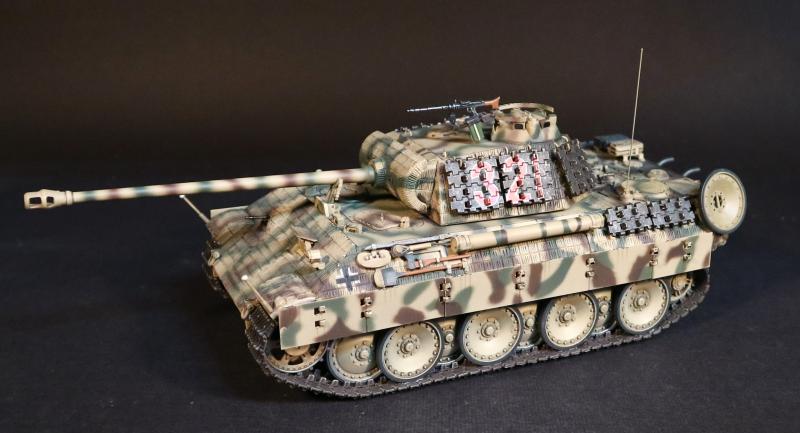
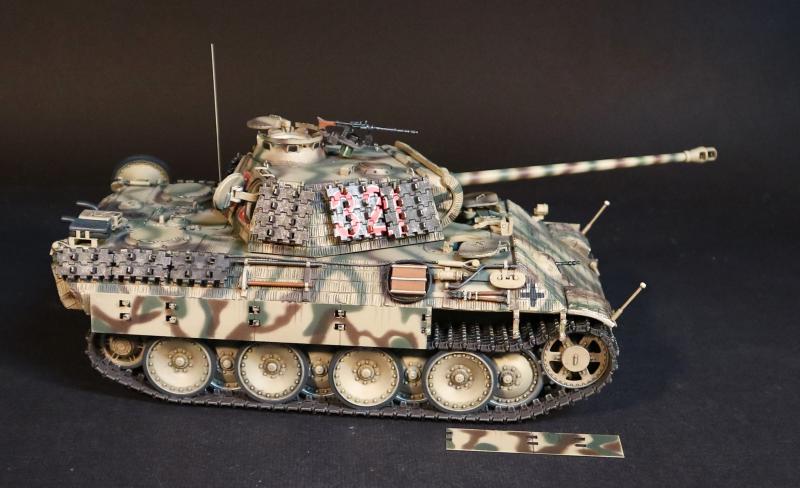
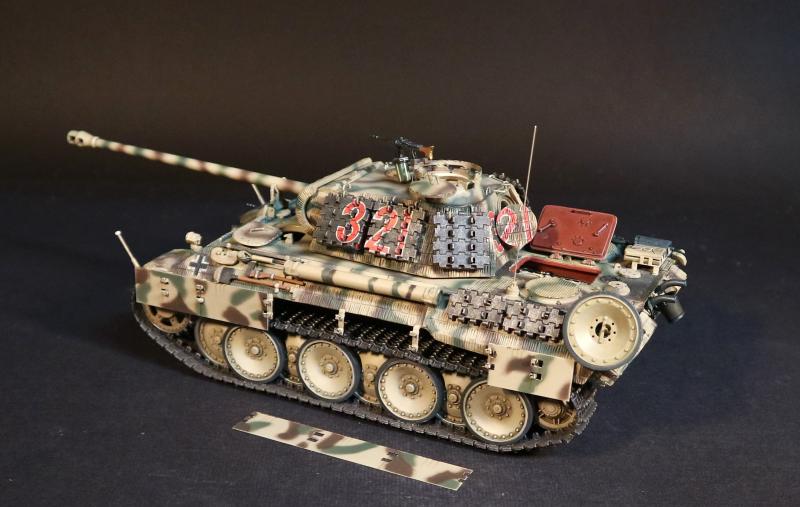
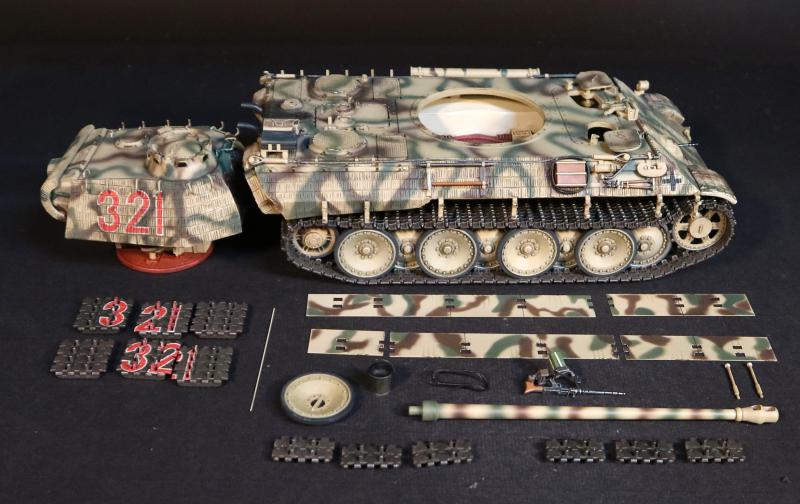
Panther Ausf. A #321, I./Panzer Regiment 6, Panzer Lehr Division, Normandy, France, June 1944, German Armor, WWII
$399.00
Future Release
Add to Wish List Notify Me When Available
Item Number: GA-45
Panther Ausf. A #321, I./Panzer Regiment 6, Panzer Lehr Division, Normandy, France, June 1944, German Armor, WWII
GERMAN ARMOUR
The Panzer Lehr Division was one of the German Army’s most highly trained and best-equipped formations. Commanded by the experienced and decorated Generalleutnant Fritz Bayerlein, Panzer Lehr was formed in late 1943 from personnel drawn largely from the German armored training and demonstration units, particularly Panzerschule I and II. The division was the brainchild of Heinz Guderian and was designed to demonstrate modern armored warfare techniques and showcase the new “1944 Panzer Division” organizational template. Consequently, Panzer Lehr was considered an elite division even before it saw combat, as it was manned by an unusually high proportion of experienced instructors and lavishly equipped with modern equipment. The division consisted of a full Panzer regiment with both Panther and Panzer IV Abteilungen, two Panzergrenadier Regiments, a Panzerartillerie Regiment, a Panzeraufklärungs Abteilung, and a Panzerpioniere Bataillon. Unlike other Panzer Divisions, where only a single Panzergrenadier battalion was equipped with Sd.Kfz. 251 armored halftracks, all four of Panzer Lehr’s Panzergrenadier battalions were fully equipped with armored halftracks. Additionally, its Panzerartillerie Regiment, Panzeraufklärungs Bataillon, and Panzerpioniere Bataillon were also fully armored.
Panzer Lehr’s organic Panther Abteilung, I./Panzer Abteilung 130, was not anticipated to complete its conversion training to the Panther in time for the anticipated Allied invasion of France during the summer of 1944. To address this shortfall, the highly experienced I./Panzer Regiment 6 (I./Pz.Rgt. 6) from the vaunted 3. Panzer Division was pulled from the Eastern Front and attached to Panzer Lehr. Recently equipped with new Panther Ausf. A tanks and composed of a high number of combat-experienced veterans, I./Pz.Rgt. 6 was one of the most powerful panzer units in early 1944 and served with Panzer Lehr throughout the entire Normandy campaign.
When Allied forces landed in Normandy on 6 June 1944, Panzer Lehr was stationed in the Paris region and was immediately ordered west toward the invasion front. The division’s movement was severely hampered by overwhelming Allied air superiority, with 134 trucks, 84 half-tracks and self-propelled guns, and 5 tanks lost to air attacks during its advance toward Normandy. Nevertheless, Panzer Lehr reached the battlefield and entered combat during the second week of June. Going into the line west of the already heavily engaged 12. SS-Panzer Division “Hitlerjugend,” Panzer Lehr brought a powerful concentration of Panther and Panzer IV tanks into the fighting around Caen and the surrounding Norman countryside.
Panzer Lehr and the Panthers of I./Pz.Rgt. 6 saw fierce combat during the defense of Caen and in the fighting around the critical Hill 112. After enduring almost a month of heavy attritional warfare against the British around Caen, on 8 July the majority of Panzer Lehr and the Panthers of I./Pz.Rgt. 6 shifted east to oppose the Americans at the Vire River bridgehead. The division was positioned around Saint-Lô when, on 25 July, the Americans launched Operation Cobra--the highly successful breakout from Normandy. Panzer Lehr was caught in the firestorm of the initial concentrated airstrikes conducted by over 3,000 medium and heavy bombers. This attack left the division severely disorganized and demoralized, and it provided only ineffective resistance during the next two days of the American penetration until Fritz Bayerlein famously declared on 27 July that Panzer Lehr had been “totally annihilated.”
Panzer Lehr later regained cohesion and participated in Unternehmen Lüttich, the doomed counterattack ordered by Hitler to halt Patton’s breakout at Avranches, before having to fight its way out of France through the hell of the Falaise Pocket. Following the fighting in Normandy, the Panthers of I./Pz.Rgt. 6 were transferred back to the East Front, initially fighting around Warsaw and then in Hungary during Unternehmen Frühlingserwachen (Operation Spring Awakening), the attempt to relieve Budapest.
John Jenkins Designs is proud to announce the release of Panther Ausf. A #321 of I./Pz.Rgt. 6 when it was attached to the Panzer Lehr Division during the Normandy campaign. Panther #321 participated in the intense Normandy fighting until it was knocked out on 25 July 1944 near St. Gilles, west of St. Lô in Normandy, during Operation Cobra.
Panther #321 was a mid-production Panther Ausf. A assembled by Maschinenfabrik Augsburg-Nürnberg (M.A.N.). It shows the evolution of the Panther design from the original Panther Ausf. D, which was little more than a prototype when it was rushed into combat. The Ausf. A featured numerous design changes and improvements meant to correct identified deficiencies of the Ausf. D, including a redesigned turret that added a vision periscope above the loader’s station, a redesigned commander’s cupola that provided increased ballistic protection from anti-tank fire, a new and improved monocular gunsight for the powerful 7.5 cm KwK 42 cannon, and the addition of a Kugelblende ball machinegun mount in the hull. Additionally, Panther #321 was coated in zimmerit, a special concrete-like mixture designed to prevent the adhesion of magnetic anti-tank mines, and gave mid-war panzers their iconic look. Unique to M.A.N.’s zimmerit application process was a vertical patch in the center of the front hull that often differed from the zimmerit pattern to its left and right. This was due to a stepped ladder stand placed in this location to provide easy access to climbing on the Panther hull during assembly and left in place until the Panther’s zimmerit was applied to the rest of the vehicle. Only then was the stand removed and the bare center patch was finished with zimmerit. Additionally, Panther #321 has the extremely large red turret numbers utilized by I./Pz.Rgt. 6 that were painted on the turret and also repeated on the extra track links hung from the turret sides to provide additional protection. Lastly, Panther Ausf. A #321 has vision distance marker rods on each of its front mudguards, that aided the driver in judging clearance distances and are seen in some historic pictures of Panther #321.
Whether displayed individually or alongside other German armored vehicles, this model is ideal for collectors seeking to recreate scenes from the fierce armored battles that defined the Normandy campaign and the Battle of France.
As standard for JJ Designs, the Panther Ausf. A #321 comes with the following features:
- Opening turret and hull hatches
- Detailed turret and hull interior
- Opening engine hatch with detailed engine compartment
- Removable Schürzen side armor panels
Many thanks once again to Steve “Hunter Rose”.
Due to be released in OCTOBER 2026.
