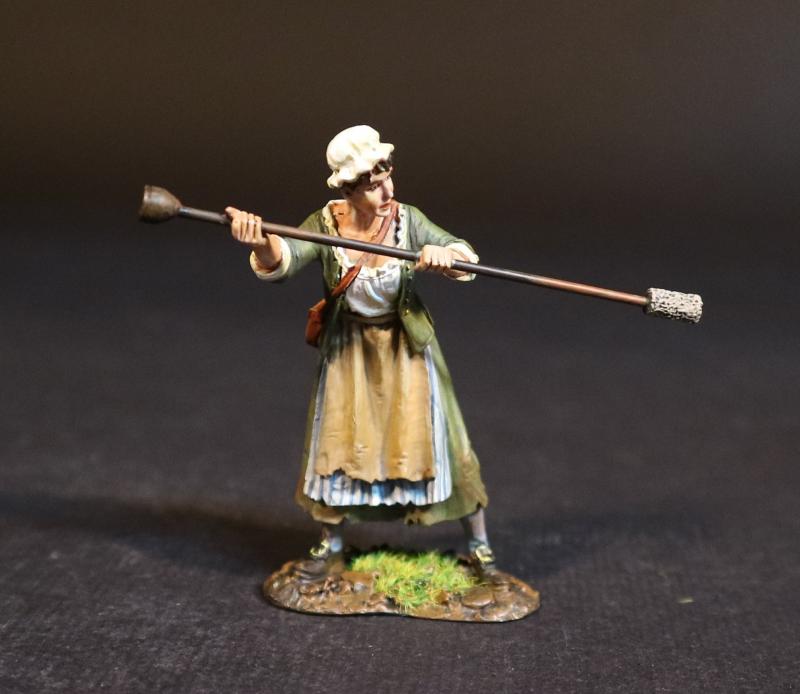
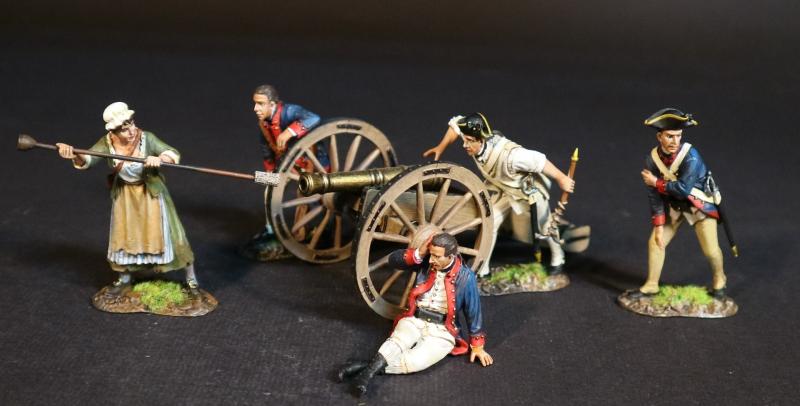
Molly Pitcher, American Artillery, The American War of Independence 1775-1783--single figure with ramrod/swabber
$54.00
Item Number: AWIART-05
Molly Pitcher, American Artillery, The American War of Independence 1775-1783--single figure with ramrod/swabber
MOLLY PITCHER
The wife of William Hays of Proctor’s Artillery Regiment, Mary was in her mid twenties, common in appearance but compact and strong. There was probably little to distinguish her from the many hundreds of other women attached to the army, except exchanging the role of water bearer ( a role performed by many camp followers of the army during combat) for that of combatant. Thus Mary Ludwig Hays became “Molly Pitcher”.
She had joined her husband at the Army’s winter camp at Valley Forge in 1777, and was present at the Battle of Monmouth, where she served as a water carrier. Her husband fell and she took his place swabbing and loading the cannon, and was later commended by George Washington.
The incident was recorded by Joseph Plumb Martin in his memoir published in 1830.
“A woman whose husband belonged to the artillery and who was attached to a piece in the engagement, attended with her husband at the piece the whole time. While in the act of reaching a cartridge and having one of her feet as far before the other as she could step, a cannon shot from the enemy passed directly between her legs without doing any more damage than carrying away all the lower part of her petticoat. Looking at it with apparent unconcern, she observed that it was lucky it did not pass a little higher, for in that case it might have carried away something else, and continued her work”.
Molly Pitcher has become a symbol of women’s contributions to the American Revolutionary War. While her story has been romanticized and may contain elements of legend, it highlights the vital roles women played in supporting the war effort.
Countless more women, whose names we may never know, served at the battlefront as nurses, cooks, laundresses and camp followers.
Historian Holly Mayer estimates that perhaps 7,000 women accompanied the American troops during the war.
Goerge Washington was to complain in 1777 that “the multitude of women in particular… are a clog upon every movement”. But he knew that the soldiers would desert without them, and that their labour was necessary.
The name “Molly Pitcher” has come to represent all women who served in various capacities during the war.
THE AMERICAN WAR OF INDEPENDENCE
The cannon used in the Revolution by all armies was the standard smooth-bore muzzle-loading gun which had been little changed in the previous two hundred years and which would serve as the principal artillery weapon of most of the world's armies for another hundred. They were cast of iron or bronze; loaded with a prepared cartridge of paper or cloth containing gunpowder, followed by a projectile. It was fired by igniting a goose-quill tube containing gunpowder, or “quickmatch,” inserted into a vent-hole that communicated with the charge in the gun; and when fired, the recoil threw it backward, necessitating it being wrestled back into the firing position by the gun crew.
The main field pieces in the war were the 3-pound galloper and the steady 6-pound field piece.
Iron guns were stronger and, therefore, could withstand bigger charges of gunpowder; most recommendations for the loading of iron cannon called for a powder charge of one-third the weight of the round shot for the gun. The recommendation for bronze guns was restricted to a charge of only one-quarter of the shot weight. Thus, iron guns could usually achieve a greater range than their equivalent in bronze; an iron six-pounder could fire 1500 yards, while a bronze six-pounder could do 1200 yards.
The advantage of bronze guns was that they were much lighter than their iron equivalents of the same caliber, so that bronze guns were preferred for campaigning, even though the range was less, since they could be moved more easily. Another advantage of bronze ordnance was that when, eventually, the gun was so worn as to be unserviceable, it could be melted down and recast; whereas an iron gun could only be scrapped. Last, but not least,, when cannon were lost at sea, bronze guns were salvagable and almost immediately re-usable, whereas even a short time immersed in sea-water was enough to destroy an iron cannon’s usefulness.
British forces used both bronze and iron artillery pieces, and within each caliber group there were generally a number of variant models. This was simply due to the incredibly long, useful lifespan of a muzzle loading cannon.
Note: Crew are not included.
Due to be released in NOVEMBER 2025.
