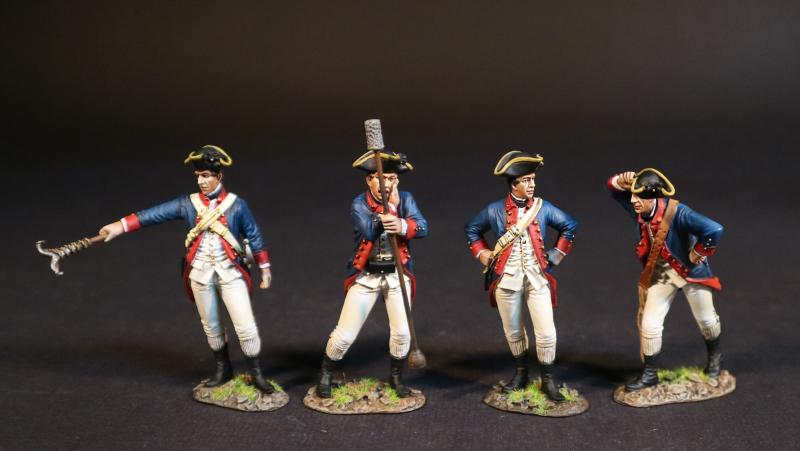

Four Artillerymen (dark blue jackets faced with scarlet), American Artillery, The American War of Independence 1775-1783--four crew figures
$198.00
Item Number: AWIART-03
Four Artillerymen (dark blue jackets faced with scarlet), American Artillery, The American War of Independence 1775-1783
AMERICAN ARTILLERY
The Continental Army’s growing pains through the first years of the war caused Washington considerable irritation. Professional armies cannot be developed overnight, and the fits and starts of the Continental Army’s creation is illustrated most clearly in the establishment of the artillery. The United States had to build its artillery from scratch, but impressively, by 1778, this branch of service was well regulated and effective.
Although the Continental Army’s artillery units were not affected by the uniform regulations as much as the infantry had been, there were still several different uniforms pre the 1778 regulations.
The change imposed on the artillery by the regulations was to make all four of the Continental regiments uniform in appearance as a branch of service and do away with distinctions between the regiments. This happened in October 1779. Prior to this, the artillery arm of the Continental army had been noted as mainly wearing dark blue coats, usually faced red.
On the battlefield itself, a crew of eight to ten cannoneers manned drag ropes and trail spikes to manoeuvre the guns into position, accomplished the intricate dance of loading gunpowder (mostly in bags of cloth or paper, but sometimes ladled loose down the barrel) and projectile down the muzzle of the piece, and set it in position to fire at the target. All artillery was muzzleloading and smooth-bore. Aiming was an art, accomplished by peering down the length of the tube and quickly making a rough calculation that combined distance to the target, weather conditions, quality of powder, and weight of projectile. Traverse was accomplished by manually shifting the entire carriage; changes in elevation were done by inserting a triangular wooden block, called a quoin, under the rear of the barrel. The piece had to be re-aimed after each shot, since there were no recoil mechanisms to return it to its original position after firing. The maximum effective range of artillery--even large-caliber guns firing solid shot--was about 1,200 yards (a mile and a half), and with untrained gunners using imperfect weapons and ammunition the range was about 400 yards. Because aiming was so imprecise, gunners invariably tried to minimize range before opening fire. Rates of fire varied with the pace of operations and, of course, the skill of the gun crew. The maximum rate of about eight rounds an hour could not be long sustained, both because of crew fatigue and overheating of the barrel
A matross was literally a gunner’s assistant and was the neophyte in the artillery enlisted hierarchy. As there was no American artillery school at this time, artillerymen were trained by their officers and NCO’s in the gun companies or “on the job” in combat. That the American artillery arm gained the high level of skill and reputation it did during the war is a testament to the dedication of the gunners that manned it.
THE AMERICAN WAR OF INDEPENDENCE
The cannon used in the Revolution by all armies was the standard smooth-bore muzzle-loading gun which had been little changed in the previous two hundred years and which would serve as the principal artillery weapon of most of the world's armies for another hundred. They were cast of iron or bronze; loaded with a prepared cartridge of paper or cloth containing gunpowder, followed by a projectile. It was fired by igniting a goose-quill tube containing gunpowder, or “quickmatch,” inserted into a vent-hole that communicated with the charge in the gun; and when fired, the recoil threw it backward, necessitating it being wrestled back into the firing position by the gun crew.
The main field pieces in the war were the 3-pound galloper and the steady 6-pound field piece.
Iron guns were stronger and, therefore, could withstand bigger charges of gunpowder; most recommendations for the loading of iron cannon called for a powder charge of one-third the weight of the round shot for the gun. The recommendation for bronze guns was restricted to a charge of only one-quarter of the shot weight. Thus, iron guns could usually achieve a greater range than their equivalent in bronze; an iron six-pounder could fire 1500 yards, while a bronze six-pounder could do 1200 yards.
The advantage of bronze guns was that they were much lighter than their iron equivalents of the same caliber, so that bronze guns were preferred for campaigning, even though the range was less, since they could be moved more easily. Another advantage of bronze ordnance was that when, eventually, the gun was so worn as to be unserviceable, it could be melted down and recast; whereas an iron gun could only be scrapped. Last, but not least,, when cannon were lost at sea, bronze guns were salvagable and almost immediately re-usable, whereas even a short time immersed in sea-water was enough to destroy an iron cannon’s usefulness.
British forces used both bronze and iron artillery pieces, and within each caliber group there were generally a number of variant models. This was simply due to the incredibly long, useful lifespan of a muzzle loading cannon.
Released in FEBRUARY 2026.
