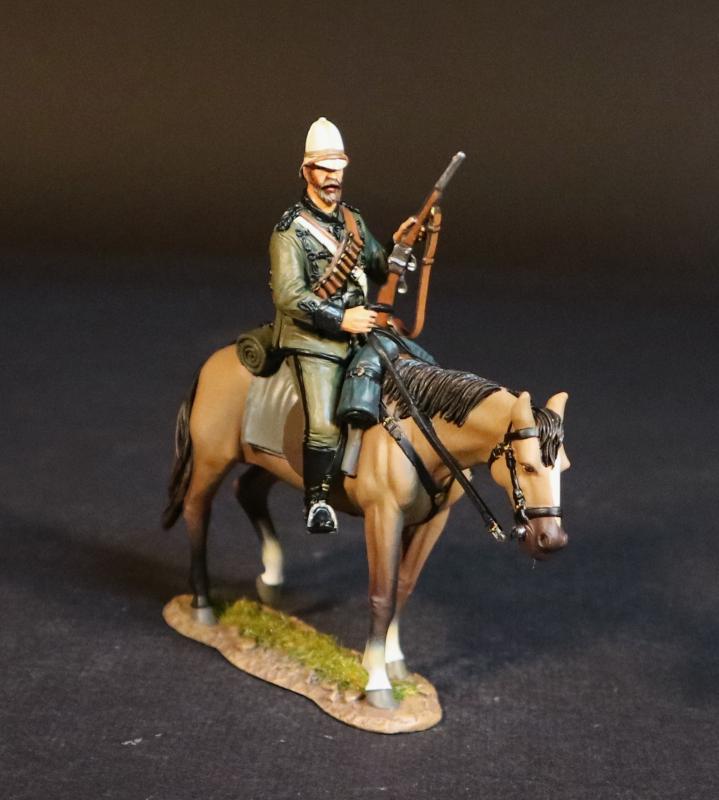
Newcastle Mounted Rifles, Volunteers, Irregulars, and Auxiliaries, The Battle of Gingindhlovu, 2nd April 1879, The Anglo Zulu War--single mounted figure, reins in right hand, rifle resting upright in left hand
$118.00
Item Number: GGNEW-01
Newcastle Mounted Rifles, Volunteers, Irregulars, and Auxiliaries, The Battle of Gingindhlovu, 2nd April 1879, The Anglo Zulu War--single mounted figure, reins in right hand, rifle resting upright in left hand
THE ANGLO ZULU WAR
THE BATTLE OF GINGINDHLOVU, 2nd APRIL 1879.
The Battle of Gingindhlovu was fought on 2nd April 1879 between a British relief column sent to break the siege at Eshowe, and a Zulu impi of king Cetshwayo. The British soldier would refer to it as the Battle of “GIN GIN I LOVE YOU”.
Charles Pearson had led No.1 column of the British invasion force across the Tugela River to establish an advanced base at Eshowe. Having set up a base at a deserted Norwegian mission station, the British found themselves besieged. A relief column was organized by Lord Chelmsford and departed Fort Tenedos on 29th March to relieve the garrison. Chelmsford’s relief force comprised 3,390 Europeans, and 2,280 Africans. Lord Chelmsford ensured his men spent much time laagering and entrenching their camp at the end of each day, and kept ammunition boxes open and at the ready. Although this was slow progress, Pearson’s observers at Eshowe were able to see the relief column entrenched on the south bank of the Neyzane, on the evening of the 1st April.
The Zulu impi was composed of 12,000 warriors, some of whom were Isandlwana veterans drawn from regiments in the main Zulu army, while the remainder were warriors who lived in the vicinity of Eshowe. Many of the Zulu commanders wanted to attack the relief column that night, but Prince Dabulamanzi KaMpande, who was half brother to king Cetshwayo and commander of the impi’s right wing, convinced them to wait until morning.
At dawn on 2 April 1879, the morning sun revealed muddy ground and a heavy mist. Chelmsford had decided after hearing Dunn's report to not continue on toward Eshowe early the next morning. Instead, he would deploy units of the Natal Native Contingent to feel for the Zulus. As the NNC were preparing to advance, shots were heard from the night pickets still on duty. The impi was advancing; the main force split into two columns before crossing the Ineyzane and assuming the "chest and horns" formation. The left horn sharply curved to the right to assault the laager's north-east corner, while the "chest" gently curved toward the north face of the laager. Another force passed Misi Hill and approached the laager, forming the impi’s right horn.
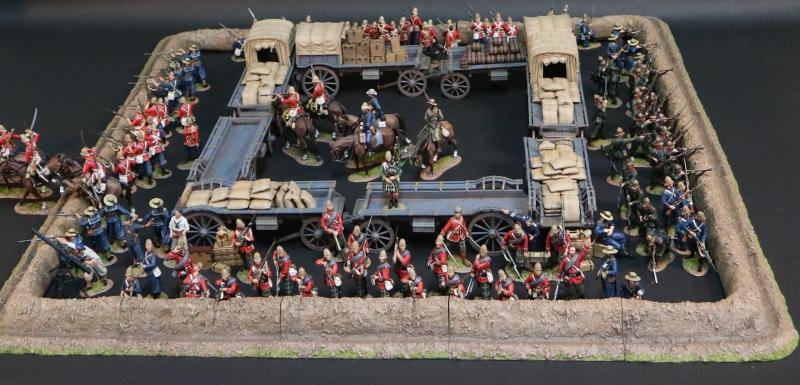
The buffalo formation came in at a run on the three sides of the laager as Chelmsford had wanted; at a range of 300–400 yd (270–370 m) the British infantry opened fire, supported by the Gatling guns and rockets.
Zulu marksmen caused a few casualties within the laager, but the defenders kept the Zulus at bay.
Although the Zulu regiments made persistent rushes to get within stabbing range, their charges lacked the drive and spirit that had pushed them forward at Isandlwana and Rorke’s Drift. The only zulu to reach the laager was a ten year old boy, who was immediately taken prisoner by members of the naval brigade and later served as a kind of mascot on their ship, Boadicea.
Around 7am, the main impi attack had been halted. Chelmsford ordered his mounted troops to attack, followed by the NNC.
Many zulu were killed as they withdrew.
Chelmsford had begun to avenge the Imperial dead of Isandlwana, but for the present, he was content to relieve Pearson and return to Natal.
VOLUNTEERS, IRREGULARS AND AUXILIARIES
NEWCASTLE MOUNTED RIFLES
Although established in 1864, it was another 11 years before the town of Newcastle, the most northerly in Natal, contributed to the ranks of the volunteers, forming the Newcastle Mounted Rifles in October 1875. The creation of the unit proved popular and by the end of the year, forty-six men had enrolled. The local Resident Magistrate, Melmoth Osborn, received the vote to become captain.
The Newcastle MR joined the Natal Carbineers and Buffalo Border Guard at Helmekaar early in December 1878 as No.3 Column concentrated for the Zulu War.
The tunic of dark green cloth had a collar of black velvet edged with black braid and a V-shaped black velvet cuff facing edged with black braid ending in a trefoil knot. The tunic was edged with black braid and decorated across the front with five rows of black braid ending in double drop loops fastened with olivets. Shoulder cords were of twisted black braid, dark green trousers bore a black stripe down the outside seam. The unit is shown in a photograph with white helmets without spikes, and there is no evidence of a regimental badge, although all other Volunteer Corps possessed them.
Due to be released in AUGUST 2026.
