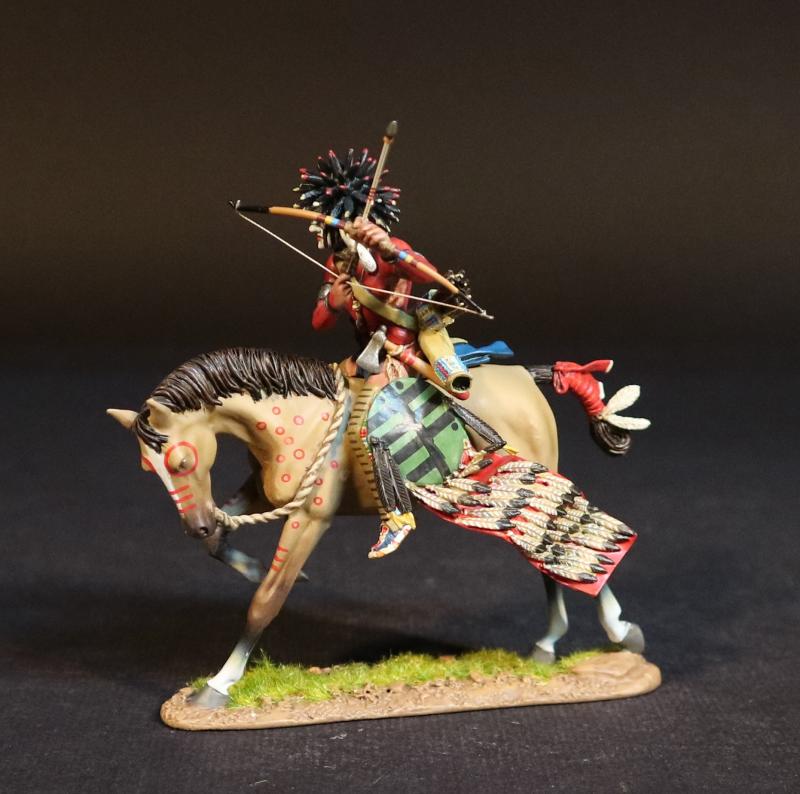
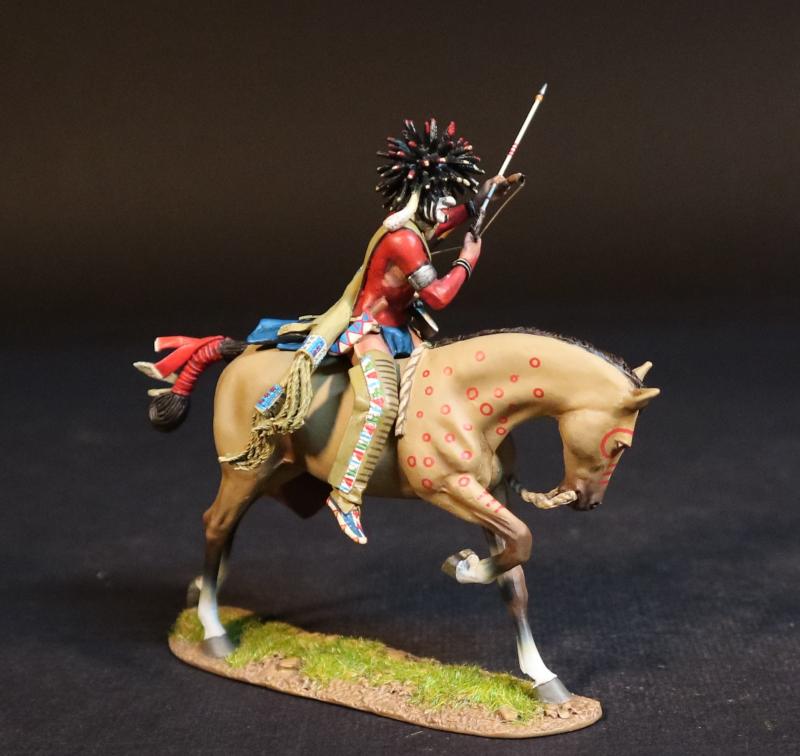
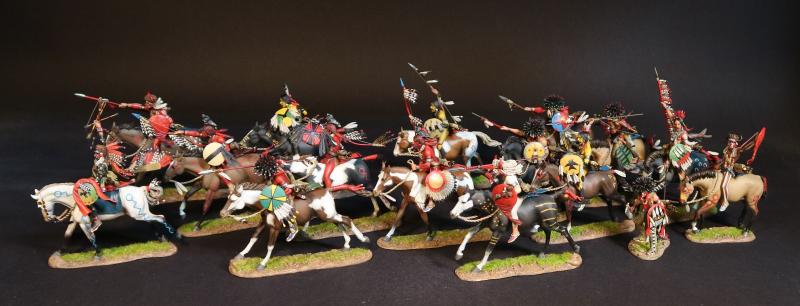
Cheyenne Dog Society Soldier, The Battle Where the Girl Saved Her Brother, 17th June 1876, The Black Hill Wars, 1876-1877, Thunder on the Plains--single figure on rearing horse, bow with nocked arrow pointed up to the left
$130.00
Future Release
Add to Wish List Notify Me When Available
Item Number: SSB-35
Cheyenne Dog Society Soldier, The Battle Where the Girl Saved Her Brother, 17th June 1876, The Black Hill Wars, 1876-1877, Thunder on the Plains--single figure on rearing horse, bow with nocked arrow pointed up to the left
THUNDER ON THE PLAINS
THE FIGHT WHEN ROMAN NOSE WAS KILLED, 17th SEPTEMBER 1868
CHEYENNE WARRIORS.
While hunting was a male activity woven into the interests of the family, fighting was an activity institutionalized in the organization of the tribes’ warrior societies. They were centered on the common experience of the members as warriors, with rituals glorifying and enhancing that experience, and with duties and services performed on behalf of the band. All were focused on war in their spirit, purpose, regalia and ritual with any religious features having their foundation in the need to influence the supernatural powers to lend their aid in battle.
Sources differ as to the actual number of the warrior societies.
THE DOG MEN SOCIETY
This was the largest society, made up of males fifteen years and older and usually contained at least half the men of the entire tribe. At an early date ,all the men of one of the tribal divisions joined the Dog Men, forming both a powerful military organization and a distinct tribal group.
The Dog Men were the famous Dog Soldiers so frequently mentioned by white observers.
The four bravest Dog Men were chosen for year long terms to defend the society and the tribe from the raids of the enemy and wore some specific regalia. This was a sash of tanned skin eight to ten feet long.
Whenever a battle was going badly for the Cheyenne, those who had been selected to wear the “Dog Ropes” for that year drove their spears into the ground and remained attached there, fighting to cover the retreat of the other warriors. It was expected that they would die rather than pull up the spear and retreat.
Society members carried bows along with the usual weapons. The usual headdress was a cap with a narrow, beaded band along the front edge, with the crown entirely covered with golden eagle, magpie, raven tail feathers, hawk and crow feathers. These were made to stand upright to achieve a spiky look.
Leggings were painted with horizontal stripes. An eagle wing bone whistle was suspended around the neck, and the upper body was uncovered and painted red, and a black face with a white skull was quite common.
This society numbered between 100-200 warriors. Originally all members wore their hair long. The buffalo headdress with the attached horns and the carrying of the shield with the tail was what led to the name “Bufalo Warriors”.
Every member carried a red painted buffalo hide shield. Round “like the sun”, it was made from the buffalo’s hips with the tail left attached. In battle, some warriors had medicine objects attached to the shield which had been dictated by visions. Whenever the warrior swung it in a circle before the enemy, it was believed that the enemy’s arrows would hit neither man nor the shield.
Every warrior of the society carried the red shield and a lance. The red shield lance was about eight feet long, straight, with a stone or trade steel point, and was painted entirely in red.
The warriors dressed alike with a buffalo horn headdress. If the warrior had counted coups the horns were painted bright red. The warriors bodies were painted either red and white stripes, or white all over.
Due to be released in OCTOBER 2026.
